Let’s unpack the concept and explore how it’s reshaping the future of automation, decision-making, and digital collaboration.
Nature as blueprint: The origins of swarm intelligence
Swarm AI draws its inspiration from the natural world, from the way ants find food, birds migrate or fish school. These creatures don’t rely on a central leader. Instead, they follow simple rules, respond to local cues and coordinate through interaction. The result? Complex, efficient behavior that emerges from the group.
This phenomenon is called swarm intelligence and it’s been studied for decades in biology, robotics and computer science. The core idea is that many agents working together can solve problems more effectively than a single, centralized system, especially in dynamic or unpredictable environments.
Swarm AI takes this principle and applies it to artificial intelligence.
What is Swarm AI?
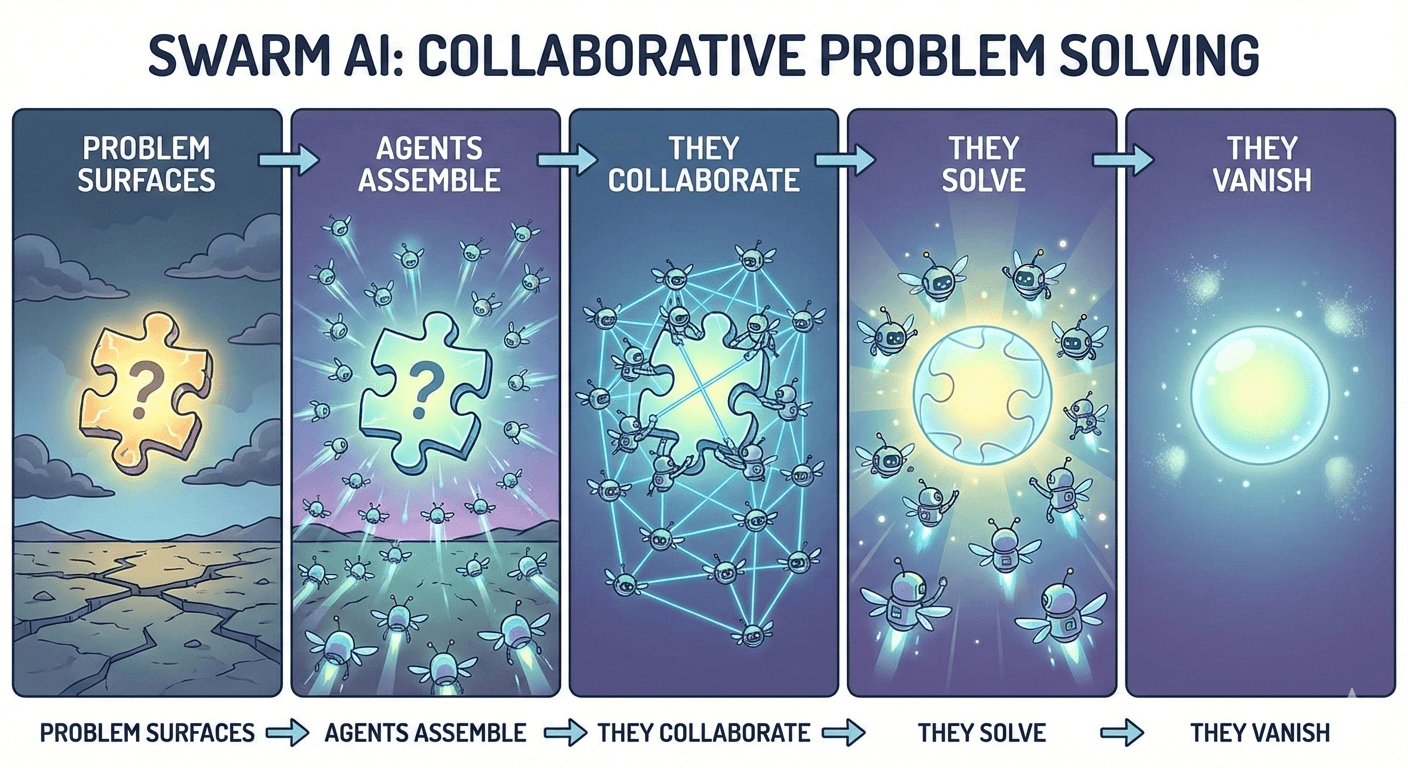
At its core, Swarm AI is a system of multiple autonomous agents - software programs, bots, or algorithms - that interact with each other to achieve a shared goal. These agents operate independently but are designed to collaborate, share information and adapt to changing conditions.
In many modern systems, these agents can be ephemeral agents, temporary, task-specific processes that are created on demand, collaborate as part of a swarm, and disappear once their work is complete.
Unlike traditional AI models that rely on a central processor or decision-maker, Swarm AI distributes intelligence across the network. Each agent has limited capabilities, but together they form a powerful, flexible system.
Think of it as a digital hive, not chaotic, but coordinated.
How does Swarm AI work?
Swarm AI systems typically follow a few key principles:
Decentralization: No single agent controls the others. Decisions emerge from local interactions.
Self-organization: Agents adapt and reorganize based on feedback from their environment and peers.
Scalability: More agents can be added without disrupting the system; in fact, it often improves performance. In some cases, ephemeral agents can be created dynamically to handle spikes in demand.
Robustness: If one agent fails, the system continues functioning. There’s no single point of failure.
These principles make Swarm AI ideal for tasks that require flexibility, resilience and real-time adaptation, from managing traffic flows to coordinating drones or even powering collaborative research platforms.
What is the difference between Swarm AI and traditional AI?
To understand what makes Swarm AI unique, it helps to compare it with more conventional AI approaches:
Decision-making
• Traditional AI: Centralized
• Swarm AI: Decentralized
Architecture
• Traditional AI: Monolithic
• Swarm AI: Distributed
Adaptability
• Traditional AI: Limited to training data
• Swarm AI: Real-time, emergent
Failure Tolerance
• Traditional AI: Vulnerable to single-point failure
• Swarm AI: Highly resilient
Collaboration
• Traditional AI: Often siloed
• Swarm AI: Built-in coordination
Swarm AI isn’t a replacement for traditional AI, it’s a complementary paradigm. In fact, hybrid systems that combine centralized learning with decentralized execution are already being explored in fields like robotics and cybersecurity.
How does Swarm AI apply to real-world applications?
Swarm AI isn’t just theoretical. It’s already being used in a range of industries:
Logistics: Swarm algorithms optimize delivery routes by coordinating fleets of vehicles in real time.
Finance: Decentralized agents monitor market signals and execute trades collaboratively to reduce risk.
Healthcare: Swarm-based diagnostics aggregate insights from multiple models to improve accuracy.
Energy: Smart grids use swarm logic to balance supply and demand across distributed sources.
Research & Policy: Platforms like FenxResearcher use swarms of agents — often ephemeral agents created for specific analytical tasks — to explore complex datasets, simulate policy outcomes, and support decision-makers.
These applications show how Swarm AI can handle complexity, uncertainty, and scale, all while remaining agile and human-centric.
Why it matters
In today’s digital landscape, speed and complexity are increasing. Centralized systems struggle to keep up. Swarm AI offers a new way forward, one that’s:
More democratic: Intelligence is distributed, not concentrated.
More resilient: Systems can adapt and recover from disruptions.
More collaborative: Agents work together, not in isolation.
More aligned: Swarm AI can be designed to reflect human values, goals, and constraints.
This makes it especially relevant in Europe, where AI governance is focused on transparency, privacy, and sovereignty. Swarm AI aligns naturally with these principles, offering a model for human-centric automation that respects complexity and context.
The road ahead
Swarm AI is still evolving. Challenges remain, from designing effective coordination protocols to ensuring ethical behavior across agents. But the potential is enormous.
As more organizations explore decentralized systems built on networks of persistent and ephemeral agents, Swarm AI will become a key tool for navigating complexity, building trust and unlocking new forms of intelligence.
It’s not just about smarter tech. It’s about smarter collaboration.
Agility, resilience and purpose
Swarm AI invites us to rethink what intelligence looks like, not as a singular genius, but as a collective effort. In nature, in society, and now in technology, the most powerful systems are often those that work together.
And in a world that demands agility, resilience, and purpose, Swarm AI may be the most human kind of intelligence we’ve ever built.